Density - Flavor, Temperature... and Latitude?
- Lukas

- Jul 8, 2021
- 3 min read
Density matters, for coffee beans. A dense green coffee bean will carry with it different flavors, and warrant a different approach to roasting as compared to a less dense greens.
Flavor
For the same volume of coffee, denser coffee beans contain more sugars and compounds, which represents more things that a roaster can develop when roasting a coffee. As such, denser beans often act as a predicator for flavorful and rich tasting coffees.
It is commonly known that the density of a coffee bean increases with the altitude that it is grown. Sustainable Coffee Institute has an amazing illustration that conveys the impact of altitude on flavors of coffee beans, and by inference, the progression of flavor profiles as coffee beans increase in density.

Altitude
Towards higher altitudes, the temperature of the air and climate decreases drastically.
As a result, coffee's cellular respiration slows down, and the green beans retain more nutrients. However, with the increasing altitude, there will come a point where the temperature gets exceedingly low, and the cultivation of coffee beans comes to a standstill due to the occurrence of frost issues.
Taking these factors into account, we can then understand that coffee cultivation typically ranges within certain altitudes, with the highest currently known being Finca Takesi in Bolivia, with an altitude of up to 2,600masl. Anything above that, and the coffee plant struggles to survive.
Yet, we also learn of the Hawaiian Kona coffee, which lies as an anomaly to the knowledge above - it cannot be grown at anything above 2,000masl, as the conditions become too harsh to grow the coffee beans at that mark. What makes it different then, from what we know of Finca Takesi in Bolivia?
The answer, lies not in the coffee bean itself, but in something else that ties back to the key factor of temperature - latitude.
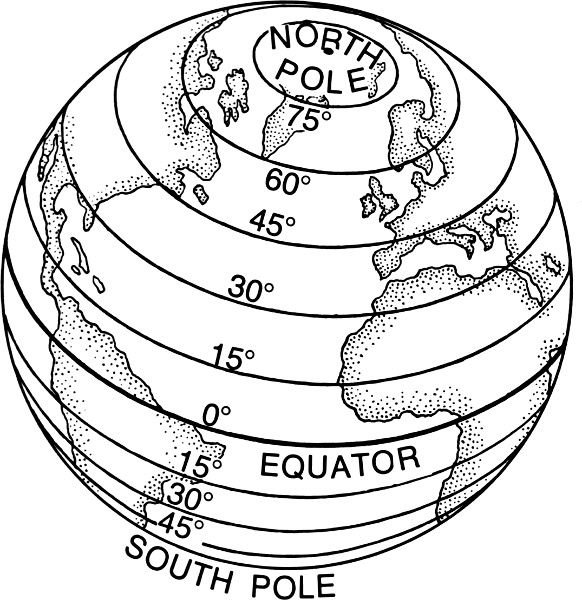
Latitude
Latitude is a geographic coordinate that specifies a location's North-South position on the Earth. It is defined by an angle, which ranges from 0° at the Equator to 90° at the North or South poles. In short, the latitude of the place can be thought of as how far away it is from the equator. And, most interestingly, the further the latitude, the lower the temperature, at the very same height elevation!
Montgomery (2006) provides in his research an updated rule-of-thumb for comparing variation in temperature with altitude and latitude, stating that:
"Roughly, a 200-meter increase in elevation is equivalent to a one-degree increase in latitude."
Tying this back to the examples above, Kona is approximately 19°N of the Equator with its harshest conditions at 2,000masl, while Finca Takesi is 16°S of the Equator with a highest altitude of 2,600masl. Taking the rule-of-thumb into account, it is a perfect fit for the comparison - the 3° differential in Latitude perfectly corresponds to the 600masl decrease in the maximum altitude for each of the farms!
Density, it seems, is not just affected by altitude, but also by latitude.
What makes this learning so remarkable is that, while altitude is a good benchmark to predict the density of a coffee bean, it does not mean that specialty coffee cannot likewise be grown at slightly lower altitudes.
So long as the temperature and other conditions such as soil and climate are right, there can be multiple permutations of conditions that may potentially yield similar qualities of a dense, flavor-packed coffee bean!
I was today years old when I learned this.


Comments